Showing posts with label Action Adventure. Show all posts

Sunday, May 1, 2016

Warren the 13th and the All-Seeing Eye by Tania del Rio and Will Staehle

Warren the 13th and The All-Seeing EyeWarren the 13th and The All-Seeing Eye by Tania del Rio

My rating: 4 of 5 stars


Review copy provided by Netgalley

What a delightfully strange journey this book has been! Warren the 13th is an odd yet endearing child who lives in and loves the hotel that has been in his family since its creation twelve generations before. His parents are dead, and so his Uncle Rupert runs the hotel until Warren turns eighteen. The trouble is that Uncle Rupert has no business dabbling in hotel management. He's lazy and not too bright, and he's madly in love with an evil witch who is using him to get to a magical treasure that will restore her to her former glory. All the while, poor young Warren is forced to act as bellhop/repairman/maintenance crew for the entire hotel, which is understandably hovering in a state of decrepit disrepair brought about by Uncle Rupert's slovenly mismanagement.

It's hard not to love Warren. He's industrious, resourceful, and kindhearted, spending all day trying to do the impossible and keep things working. He has few friends, but they are steadfast and noble. His tutor and the hotel chef are odd characters as well, but they are noble and honest through and through. His evil Aunt Annaconda is the only person actively trying to make life more difficult for Warren as she attempts to uncover the secrets of the All-Seeing Eye, a possibly magical devise that she believes is housed somewhere in the hotel grounds.

The style of this book is certainly unique, from the column style of the writing to the illustrated text and odd illustrations, everything about this book screams quirky (which is an appropriate statement to make considering the publisher). The thing is, it all works so well together that you can't help but enjoy the experience. This is a great adventure with a healthy dose of mystery and magic heaped on top. I'll certainly be adding this to my school's collection. If I can say nothing else for the story, the fact that the book is so odd will sell a large segment of students on it, no questions asked. Add to that the fact that the story is well told and heartwarming to boot, and you know you're dealing with a winner. Well done.


View all my reviews

Over the Underworld (Book 2 of The Unbelievable FIB) by Adam Shaughnessy

The Unbelievable FIB, Book 2: Over the UnderworldThe Unbelievable FIB, Book 2: Over the Underworld by Adam Shaughnessy

My rating: 5 of 5 stars

A year ago, I was provided with an ARC of a book called The Entirely True Story of the Unbelievable FIB. It was an odd looking book with an equally odd title. It didn't appear to be a part of a series, and I had never heard of the author before. It just looked strange, and I wanted to know more about it. That book turned out to be the best book I read all year. I voted for it to win the middle grade category of the Goodreads choice awards, I bought it for my school library, and I recommended it to every colleague, friend, and family member that I caught in another boring conversation about the books I was reading. Sadly, I thought that was the last I'd have to do with The Unbelievable FIB.

So you can imagine my excitement upon learning that The Unbelievable FIB was coming around for another adventure. There was a new cover for the first book (nice, but I'm still a fan of the original cover), and a second book was on the way. Once again, I applied for an ARC from Netgalley, and after a week of hoping and waiting, my request was granted. I was in the middle of reading a few other books, and I tried to tell myself to wait until they were finished, but the part of me that remembered the last book wouldn't let me put it off.

Yesterday, I began reading Over the Underworld, and I have to say that I kind of let the world stop as I dove in. This time around, the cast of characters were all back, and the adventure started as soon as the book began. I was transfixed. I read and read, until much to my dismay, my e-reader simply ran out of battery. Curses! I was 82% through, and I was forced to a sudden and complete stop. Reluctantly, I let myself be drawn back into the world of people and batteries that don't last long enough to let me finish what I am reading. I plugged in my device to charge, and went on a walk with my wife, who I had been neglecting for the past couple of hours. Fast forward to this morning, 7 A.M. on a Sunday morning, and where do I find myself? Exactly where you'd expect an obsessive reader like me to be, lying in bed with my e-reader propped on my chest devouring the last 18% of Over the Underworld!

This book finds ABE and Pru, a year removed from their previous adventure, feeling neglected and forgotten. Life in Middleton has returned to sleepy small town boredom, and Mister Fox, Thor, Loki, and Odin have all been no shows since the mess with the giants has been sorted out. Pru is angry with Mister Fox for not returning. She feels used. ABE has a cooler head about everything, a theme that runs throughout this second story. In fact, an unexpected twist to this second book is that ABE has seemingly become the lead character. Pru is still significant and a good deal of the story is still focused on her perspective in everything, but ABE is the featured character here. Seventh grade is beginning and he is seemingly more focused on that going well than on reembarking on madcap investigations into the doings of the Norse gods and giants.

Still, when the two receive a summons to a council in Odin's home, they immediately comply and find themselves in the presence or more god-level turmoil. Baldur, Odin's favorite son, is dead and all signs seem to point to Loki being the murderer. Mr. Fox arrives on the scene soon early in the council meeting though with every intention of investigating the murder and possibly prove Loki's innocence. Pru and ABE soon find themselves investigating Baldur's death from the magical Hen House headquarters. Meanwhile, Thor and Hilde have been dispatched to round up the number one suspect, Loki, who has predictably gone into hiding.

Just as in book one, the investigation revolves around finding uncertainty, the real key to magic according to Mr. Fox. ABE receives visions wrapped in riddles that he alone can decipher the answers to. Pru, meanwhile, is coming to terms with her rocky start in seventh grade and the feelings of abandonment that being left in the dark about FIB business for a year has brought about. No one is above suspicion in this volume, just as in book one. Ragnarok is coming undoubtedly on its way, and time is of the essence.

This book is less focused on Middleton, with most of the real action occurring in the worlds of the gods and Middleton only being the place that the children return to regularly to attend school and interact with family. The real climax occurs in the world of the dead where once again there is a significant clash between the gods and the giants. The last few chapters offer up enough twists, both devastating and shocking, to leave you reeling and ready for what's to come in the next book. This book felt more like a part of series with a larger unresolved story arc rather than a book that just knocks you out with its greatness and leaves you wanting to reread to scoop up all the bits you missed on your first run-through.

I liked this second book in the series, though I was more impressed with the first book. It was certainly a compelling adventure, but certain elements were curiously light such as the bits of puzzling wisdom that Mr. Fox was so generous in serving up in the first adventure in Middleton. It seemed that every other line in book one was designed to bend the reader's mind just a little bit further, while in this book the adventure and the characters' intentions were fairly straightforward. I'm still on the hook for the third book in the series, which is a virtual certainty at this point, but I hope that in book three, some of that mind-bending, thought-provoking dialogue makes its return.

View all my reviews

Saturday, April 30, 2016

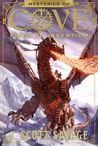
Fires of Invention by J. Scott Savage

Fires of Invention (Mysteries of Cove, #1)Fires of Invention by J. Scott Savage

My rating: 5 of 5 stars


Review copy provided by Netgalley

This was a most unusual mixture of science fiction, dystopia, and fantasy. In the underground city of Cove, where technological advancement has been brought to an utter and complete stop, Trenton is at odds with himself. He is a mechanical whiz with a penchant for seeing potential improvements to his city's machinery and equipment, but also a devout believer in the city philosophy that curiosity, creativity, and inventiveness brought about the downfall of mankind everywhere except for Cove.

Trenton deals with a heavy sense of self-loathing as his mind continues to create while his sense of duty tells him that he should be able to suppress his creative urges. Into this mix comes Kallista Babbage, the only daughter of infamous inventor, Leo Babbage. She's not an easy sort of personality to be around, having lived most of her life as a defensive loner. She is a strong individual, hellbent on vindicating her father's work and restoring his reputation, which is is in ruins after an explosion that supposedly killed him and a number of residents in an apartment building where he was fixing a water heater.

Though their initial meeting is brought about by happenstance and Trenton is understandably resistant to being associated with Kallista, the two characters begin to work together when Trenton's mother prevents him from receiving an assignment to become a mechanic and he finds himself unable to pursue the career path that he has aspired to for as long as he can remember. What ensues is whirlwind adventure wherein Trenton and Kallista discover information that breaks down their previously held perceptions about their city and its beliefs. There is great risk and dire consequences for their behavior, but as information leads to inspiration and inspiration leads to invention, they both realize that there is no turning back for either of them.

This is a beautiful story, one that will leave readers both reeling and thoughtful. Characters are complex and multi-dimensional, and themes such as trust as friendship are as central to the plot as the "steam-punk" mechanical drive of its protagonists. I was more than a little impressed with this story as a whole. I can't wait to get my hands on the next volume in this middle grade series. This is sure to be a hit with the upper middle grade crowd as well as the young adult audience.


View all my reviews

Thursday, April 14, 2016

Scrap City by D.S. Thornton

Scrap CityScrap City by D.S. Thornton

My rating: 5 of 5 stars


Review copy provided by Netgalley

This book sucked me in and stole hours of sleep, something I don't get enough of as is, but I don't hold that against it because it gave me hours of pleasure in return. It was hardly typical of the fantasy genre with the overabundance of robot-like characters called Scrappers, but this was a worthwhile read in the fantasy genre.

Jerome Barnes is a protagonist that comes with a lot of baggage. His mother and his younger brother, Max, died tragically in an accident and Jerome blames himself. As a result, he isolates himself from others as he has lost all faith in the dependability of relationships. His father is dealing with the loss by throwing himself into his work as a real estate agent, making Jerome feel even more isolated.

The story springs out of Jerome tagging along on one such real estate deal, as his father attempts to convince the town junkman to sell his junkyard to a developer. While at the junkyard, he meets a mechanical boy named Arkie and is drawn into a secret world that exists at the junkyard.

This book really had me hooked from fairly on. At times, Jerome was hard to take since he puts on such a flinty exterior, treating Cici, a girl who tirelessly tries to be friends with him, like a nuisance, but you can tell through it all that he is just a kid dealing with a bad situation in the only way he knows how.

The Scrapper world of Smithytowne is definitely the most alluring part of this story. It has a Hogwarts-like appeal,a world that exists alongside the rest of the world, yet remains entirely undetected. There is a magical element in what brings the Scrappers to life, but it's a minimal piece of the story. Mostly, the story is centered on equal parts mystery and adventure as Jerome becomes more entangled in the world of the Scrappers and the effort to save the junkyard that Smithytowne lies beneath from what turns out to be an evil developer.

While I don't read stories like this often, I was impressed by this from start to finish, and I am certainly going to add it to my library collection as soon as I can. I recommend that elementary and middle school libraries all do the same. If you don't, you're missing out. This was a real pleasure to read.


View all my reviews

Monday, March 14, 2016

The Blood Guard by Carter Roy

The Blood Guard (The Blood Guard, #1)The Blood Guard by Carter Roy

My rating: 4 of 5 stars


Review copy provided by Netgalley

If I was looking for a new series to bring me back to the middle grade fantasy genre after polishing the latest Rick Riordan or Eoin Colfer book, this would be the perfect choice. It has all the characteristic unrelenting action and sarcastic banter that have come to be genre mainstays of late. This is the story of boy whose parents lead secret lives while he leads a life of preparing for a destiny that is secret to him. I could probably write that same sentence to describe the beginning of a dozen different series written in the past dozen or so years, but it strangely doesn't mean that this book was any less satisfying for it.

This series is bound to have a fairly massive audience, and the best news is that it will leave that audience fairly satisfied so long as what comes next is as good as this first book was. One concern I have is that there is a noticeable lack of variety in the encounters with the villains. Maybe it's the fact that most of the villains are soulless thugs that behave in a predictable manner, but when the heroes have escaped from the same group of brutes over and over again, the concern becomes whether the experience remains fresh. It wasn't much of a problem in this one, but I see how it could become redundant in future volumes.

All in all, this was a good start to a series that could the next big one in the genre. It maintains an unrelenting pace and the characters are all fairly relatable. The banter is fun, lightly sarcastic, humorously oddball, and consistently action-driven. It will leave you hanging in the end, wanting the next book so you don't have to pause in your ravenous consumption. Maybe you'd be better off not starting this one until the next book is out if you're the reader that I just described. Nothing worse than having to wait to find out what happens next.


View all my reviews

Saturday, January 30, 2016

The Night Parade by Kathryn Tanquary

The Night ParadeThe Night Parade by Kathryn Tanquary

My rating: 5 of 5 stars


Review Copy provided by Netgalley

This is a thrilling read that is sure to engage readers from the moment the magic of the first begins. Set in a mountainside village in Japan, this is the story of Saki, a sullen teen from Tokyo forced to leave her beloved city for a family visit to her grandmother's home and the annual celebration of Obon. Sami starts the story as a rather unlikable character, more interested in her phone than her family. She has awful friends that are the very embodiment of the mean girl mentality, and she thinks there is nothing more important than impressing and appeasing the worst of them all, the manipulative leader of the group, Hana.

Neither Saki, nor her younger brother Jun, nor even her parents seem particularly thrilled with having to go, but they are going out of a sense of familial obligation. Saki's grandmother is probably the most likable character of all in the beginning. However, Sami soon falls in with the wrong crowd in the village and sets in motion a curse that she can only undo by traveling into the world of spirits known as the Night Parade. Over the course of three nights, she must find a way to lift the death curse she brought on with the help of the guides. However, her task will be none to easy as she soon discovers, and the consequences of failing are too great to risk.

I loved that this was a children's fantasy set in the world of Japanese folklore. It was such a refreshingly new angle. As a reader, I was entirely unaware of the celebration of Obon, and everything about this story seemed invite another unexpected chance to gain further insight into Japanese culture. While this is a highly appealing title for readers of the fantasy genre, it will hold equal appeal for YA teen readers. Along the way a reader will inevitably gain a deeper appreciation of Japanese cultural customs, which is a nice bonus. Certainly a worthwhile read that should make a big splash in fantasy market this year. Well done.


View all my reviews

Friday, July 31, 2015

Benji Franklin, Kid Zillionaire: Money Troubles by Raymond Bean

This book is set to be released tomorrow,  August 1, 2015, along with a few other books from Capstone Young Readers that I've previewed through NetGalley. It is probably categorized as middle grade fiction, though I would say that it probably fits best in a category I'd call younger middle grade fiction. It's the fourth Benji Franklin book to be published, and the first Benji Franklin book that I've read. Capstone has created a web page about the series, so if you want to know more about it, click here for the link. If not, below is a paragraph from NetGalley about the book, and what I thought can be found below that.

Benji Franklin is the world’s go-to super genius. He’s already saved the planet twice before, and now he’s at it again. With the help of his extraordinary problem solving skills (and a solid gold submarine or two), he’ll be busy stopping dangerous underwater earthquakes and catching outer-space cyber criminals! But with balancing saving the world and doing his homework, are there some problems too challenging for even the Kid Zillionaire?


Benji Franklin: Kid Zillionaire kind of sums up the tone of this book right in the title. Benji (that's short for Benjamin) is a boy with so much money that a real number just won't do to describe it. (If you are unaware, there is no actual number that is assigned the name zillion. It's just a word people use when they are talking about a quantity so enormous that real numbers aren't cutting it.) In short, Benji Franklin is supposed to be a modern adolescent who is so wealthy that mathematics cannot adequately describe his bank account.

What does the egregiously wealthy child do? He makes extravagant and senselessly expensive purchases (like a gold submarine with orange lightning bolts on the side), attends elementary school like a normal child, and solves problems for inept rich businessmen who value discreet service more than expertise. This book isn't meant for the analytical reader that will slowly pick it to pieces. It's pretty easy to poke holes in everything from the plot, to the characters, to the incidental details that just don't seem to add up (like a spaceship that needs a spacious runway to land despite having the ability to hover while magnetically picking up or dropping off a submarine). This book is meant to be a zany and fun caper with cartoon-like silliness and suspense. As Kirkus Reviews so perfectly described the first book in the series, "This book is the best cartoon that Hanna-Barbera never made." Think of it like Tony Stark and/or Bruce Wayne having a richer nephew that decides to be a private investigator instead focusing on finishing elementary school. He's a bit of a braggadocios egomaniac, going so far as to as to refer to himself as a superhero simply because with enough overpriced gadgetry and fairly transparent nonviolent criminals to outwit, he's been able to repeatedly save the day.

I can see this appealing to 7 and 8 year old boys particularly, as Benji lives an adolescent boy's fantasy life. He's rich beyond anyone's wildest imaginings; the whole world (including his parents and his school principal) kind of bows to his greatness, and his only real adversaries are a girl from his class named Cindy with whom he maintains a battle of wits for elementary school supremacy, and an ever growing pile of schoolwork that he can't seem to fit into his busy "superhero" schedule. I laughed a couple of times as I read this, and I'm sure the right reader would do the same. All in all, it's a good read for it's intended audience. It's a bit nonsensical and even a little delusional at times, but if you can buy into the insanity, it can be a fun ride.

Sunday, December 1, 2013

Season Greetings and a Few Season's Readings

I'm beginning to think I should rename this blog something like The Sporadic Reviewer or A Reader Writes Every So Often. After all, looking back on my posting history, I write in bursts of fervor that are immediately followed by dry spells that would leave the average reader wondering if I've been abducted by aliens (provided that they believe in that sort of thing). Here I am, back for another post, and it's been about six months since my last foray into the blogging universe. I hope you weren't holding your breath.

I suppose the irony of these blogging lulls is that they very rarely coincide with reading lulls. This summer and fall have been great reading times for me. I've read well over a hundred books since my last post. I've previewed easily three hundred more. That's something I've been doing a lot lately. I have a Nook Color e reader and I use the thing constantly, though I don't buy many books on it. Instead, I shop the Barnes and Noble marketplace for new and interesting fiction and I download the preview for books that I like. After reading the preview, I decide if it's a book that I'd like to buy a print copy of. The previews are free, so I get to do what I would do if I were allowed to spend all the time I'd like to browsing a bookstore.

For every misunderstood
super villain, there is a
chance for redemption.
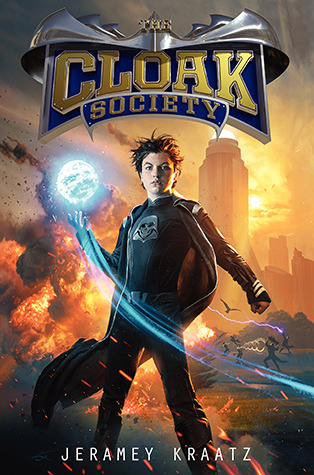
I have a favorite book of the year. It was The Cloak Society by Jeramey Kraatz, a book about a super villain in training and the dilemma he faces as he comes to terms with the idea that he's been fighting on the wrong side his entire life. The young super villain is part of a collective of super villains that includes his parents, and his internal struggle of loyalty versus following his conscience is a emotionally charged roller coaster. Kraatz is a new author for me, but his debut blew me away. There's a second book in his Cloak Society series already, and I've been looking forward to picking it up for a while. I kind of can't believe that I have already.

A great Veteran's Day read.
I've read a few picture books that were equally impressive in the past few months. The Poppy Lady is the Veteran's Day picture book that I've been looking for for years. It tells the story of Moina Belle Michael, an obscure historical figure whose efforts to honor the efforts of WWI and WWII veterans resulted in the sale of poppies on Veteran's and Memorial Day to this day. I have to admit that when I read this, I didn't know anything about poppy importance and I'd certainly never heard of Moina Belle Michael. This one of those circumstances where I read, I called my fellow teachers up, and by that afternoon I had a lesson planned that involved reading The Poppy Lady to an entire grade level.

I wish I had the determination
of the bird in this story.
More recently, and on a far less serious note, I thoroughly enjoyed How Rocket Learned to Read by Tad Hills. Here is a book that every teacher can appreciate. Rocket is a dog that enjoys the dog life. He is simple-minded, content in his routine, and happy. Then he meets a bird that messes all of that up, and he's a lot better off because of it. The bird is what really won me over in this book. He's truly unflappable (excuse the awful pun) in his mission to make Rocket a reader. Rocket turns out to fit the prototype of reluctant readers to the letter. The bird wins him over with great literature that Rocket just can't ignore, which is usually the best way. For anyone who's ever met the kid that that just didn't want to like reading, no matter what you try, this book is here to reinforce your beliefs and reassure you that your efforts are worth it. It's a simple ten-minute read, but you won't regret it. I didn't.

Anyway, if this is the holiday season for you, have a good one. If it's not the holiday season, I hope that  these books brighten your winter months. Of course, if you're reading this in the southern hemisphere and the temperature is approaching that of boiling water, maybe an air conditioner is a higher priority at the moment. Give these books a look when you get a chance. Happy reading, everyone.

Sunday, March 24, 2013

Oz, the Book and Movie Monster

I'm one of those oddballs who has read The Wonderful Wizard of Oz and a couple of the sequels in the Oz series. Now, I know that in the world at large that hardly makes me unusual. Those books have been read by a lot of people. I'm not going to pretend that I have any idea just how many people that might be, but I know I'm in good company. However, among the people I spend my time with, I'm kind of alone in that capacity. Because of that, when I went to see Oz, the Great and Powerful with my wife and a friend, I was the only one who was quietly drawing comparisons between the book characters and the characters they'd developed for the movie. I knew being the guy that voiced all those comparisons to an unappreciative audience wasn't cool, so generally I tried to keep my thoughts on the matter to myself. In the case of this most recent movie adaptation, I was actually very happy not to bring it up. I was already aware that Oz, the Great and Powerful wasn't intended as an adaptation of one of the original books. If anything, I suspected this movie would do more to reignite interest in the books than draw comparisons to them. With that thought in mind, I thoroughly enjoyed the movie. It was a beautiful film with astounding visual effects and a heartbreaking love story carefully woven into the plot.

A new movie is hardly a revolutionary incarnation for the series though. Oz stories have been produced in nearly major medium in existence, dating all the way back to the days of L. Frank Baum who dabbled in plays, silent movies, and various other formats for his famous series. Not every attempt to present the series in a new way worked even then, at the peak of Oz's popularity, and Baum was dealt many failures during his lifetime. Luckily, setbacks didn't stop his writing. He wrote the first fourteen volumes in the Oz series. That's twice as many books as J.K. Rowling wrote for Harry Potter. Essentially, Oz is the series that keeps on giving. And I like that. I also like that the series didn't end at the time of Baum's death. As terrible as it is to lose the original creator of any series, the decision to keep the series going with Ruth Plumly Thompson assuming the author role meant that by the time I came along to read the books, I had an overabundance to choose from.

This is a wonderful series to pick up today. Despite its being more than a century old, Oz is still highly readable. The text hasn't become so dated that casual readers wouldn't understand what was happening, and the plots of the original books are right on par with the popular fantasy series of today. Better than that, if you are among the growing number of readers that read electronic books, most of the Oz series is available for free online. Be aware that not every book will revolve around Dorothy Gale, Toto, Scarecrow, Tin Woodman, and Cowardly Lion. While those characters do return to the series time and again, new characters become the focus in every volume. The Marvelous Land of Oz, the second book in the series, does not incorporate Dorothy at all. New characters have their own quests, ambitions, vices, and allegiances. Also, realize that the land of Oz won't always by the setting. Ozma of Oz, the third book, is set almost entirely in another magical land called Ev. Despite it being just across the desert from Oz, Ev is its own land with its own creatures and leadership. Dorothy and the Wizard in Oz starts in an underground fairy world populated by vegetable people called the Mangaboos. Their city is called the Glass City.

All in all, this is the sort of series that you should try. If you're like many of my peers, the Oz you'll find in the books is a land that can allow that moment of escape when you need it. Not unlike Dorothy, you could probably use an occasional escape from the otherwise gray monotony of your lives. I know I do sometimes.

Saturday, March 16, 2013

Book 10: Captain Underpants and the Revolting Revenge of the Radioactive Robo-Boxers

-from Pilkey.com
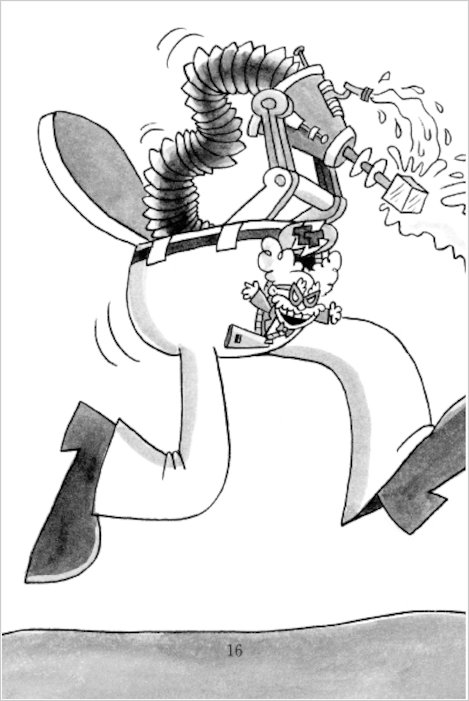
Well, I've finished book ten and I'm confused. The first piece that baffled me was the title. Other than the fact that Captain Underpants rips the robo-pants off of the third and final incarnation of Tippy Tinkletrousers, leaving him to give chase in a pair of boxers for a couple of chapters, robo-boxers weren't much more than a footnote. I suppose the "Radioactive" might have referred to the abundance of nuclear bombs used in this particular epic novel. The "Revolting Revenge" part might refer to the crazed acts of the three Tippy Tinkletrousers when they each discovered that in order to beat Captain Underpants they might have to blow themselves up and seriously effect the fabric of history in the process.

I hope that by now you're as confused as I was. If you've been reading along in my challenge up to now, you know that in my last post I mentioned the sudden and rather graphic demise of Tippy Tinkletrousers. Well, like many readers, I was tricked. I bought into the red splatter explanation for the end of Tippy. I thought things were looking bleak, not only for the world of Captain Underpants, but for the tenth epic novel. His creativity and cleverness were back, but his plot was running into one roadblock after another. Well, Dav Pilkey has a new trick up his sleeve. What I call retraction he calls misdirection. I'm not sure most magicians would agree with his label since most of them have made their entire career by building an act around real misdirection, but if he wants to call what he does misdirection, who am I to judge?

Anyway, it turned out that the world of Captain Underpants hadn't rid itself of Tippy Tinkletrousers (aka Professor Poopypants) just yet. He still was out to seek his revenge with some more robotic-man-to-superhero-man combat, all courtesy of more outlandish and contradictory time travel loopholes. If you're familiar with book nine, you're aware that a major undertaking of the plot was not to violate the Banana Cream Pie Paradox. If you're not familiar with this paradox, basically it means that you can't go from the present into the past and somehow change that past without seriously messing up the present that you left behind; furthermore, if you mess up the present you left behind, that messed-up present might mean time traveling to the past wouldn't have happened and time and all the events connected to time make no sense anymore. If that explanation confuses you, read the comic strip in chapter two of book nine and it will all become clear…or not. Bottom line, time travel is really messy business no matter how you look at it. So bring on the comic hi-jinx and throw logic into another dimension because this epic novel is intended to blow your mind.

from scholastic.com
Pilkey decided that the best way to make things really interesting was to have Tippy continually jump back and forth through time as he tries to avoid destroying the world while still attempting to destroy his arch-nemesis, Captain Underpants. Along the way, he meets up with a past version of himself who eventually multiplies through more time travel into a third version of himself. All three then set out to complete their task. The funniest part of the work of these three is that they don't work well together. Throughout most of their time together, they are their own biggest obstacle on their road to successful destructive behavior. They regularly attempt to one-up each other, slight each other, sabotage each other, and basically prevent each other from being the one that experiences the joy of finally defeating Captain Underpants. In a lot of ways, they beat themselves. By my calculations, their collaboration is also a complete violation of the Banana Cream Pie Paradox. However, if you look past that, it's not too hard to spot the better qualities of the story.

This is the first Captain Underpants epic to incorporate Ook and Gluk's cave people, thanks to some more time travel. This is also some of the more creative Flip-O-Rama in the series. You have the cave people to thank for that. I liked that he dabbled in alternative history, though the explanations for the start of the universe, the end of the dinosaurs, and the ice age were a little bit redundant. Nuclear bombs and ray guns can't be responsible for every important event in our history. Well, they can, but that gets boring after a while.

The ending was kind of predictable for anyone who had been reading all of Captain Underpants past encounters with Professor Poopypants/Tippy Tinkletrousers. He did go out with a bang at least. I won't say that I think he's really gone since that really seems to depend more on whether Dav Pilkey needs to squeeze a bit more mileage out of the villains he already created. At least Tippy is gone for now, and another adventure involving Melvin Sneedly seems to be in the works. Who knows what the future holds? For now, I'm all caught up.

Friday, March 15, 2013

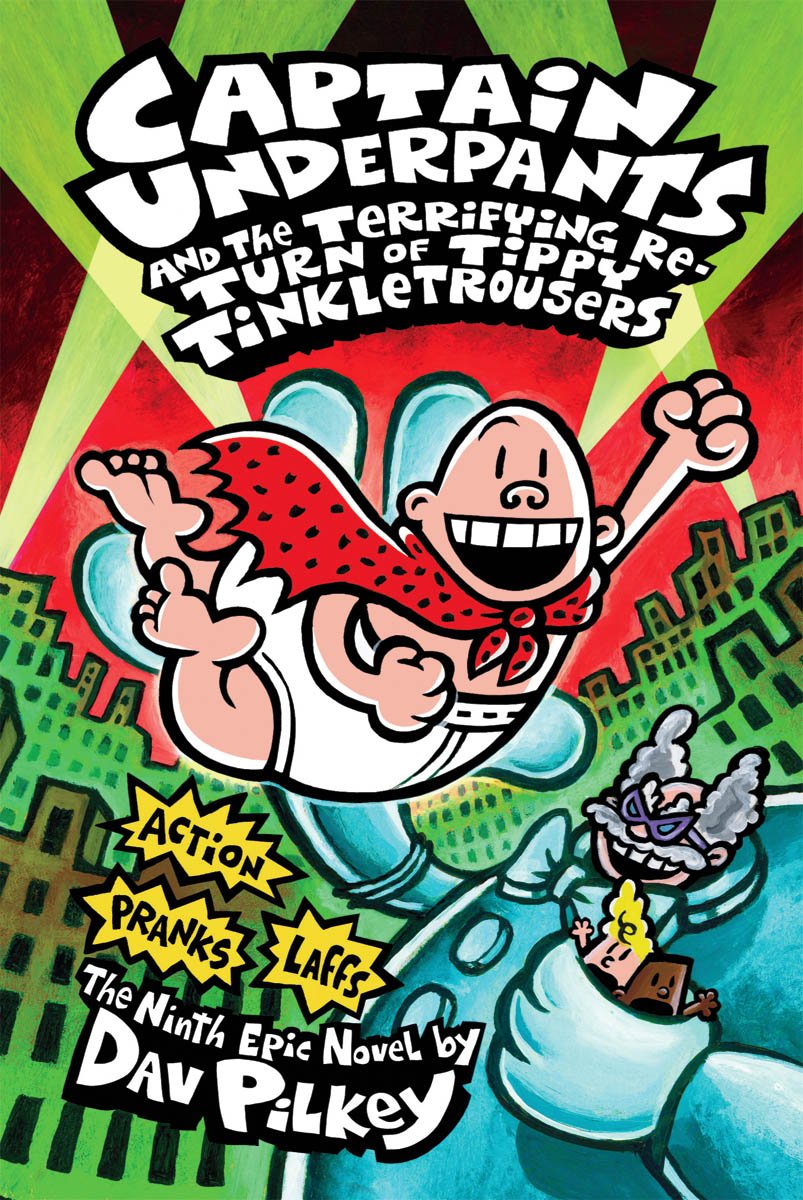
Book 9: Captain Underpants and the Terrifying Return of Tippy Tinkletrousers

This was a refreshingly wild ride. Never mind the fact that the first chapter of book nine was basically a retraction of the final chapter of book eight. Never mind that the second chapter was a strange and comical demonstration of a time travel paradox titled The Banana Cream Pie Paradox. (By the way, I thoroughly enjoyed that demonstration.) Maybe it's the fact that I took a two-year break from the series, or maybe it's the fact that Dav Pilkey took a six-year break, but book nine has seemingly given the series new life.

It certainly wasn't the story I was anticipating. For one thing, I was expecting Tippy Tinkletrousers to take a larger role over the course of the story since his return was the focus of the title. Instead, his rampaging escape from prison and his brief quest for revenge against Captain Underpants were the focuses of chapters three through eight after which the reader could basically forget about him until he briefly reappeared in chapter thirty-one. He regained the spotlight in chapter thirty-two, but Tippy's role in the book (and presumably the remainder of the series) ended abruptly in the one-word chapter thirty-three. (I wasn't too crazy about the choice of illustration in chapter thirty-three.) He hardly seemed like a title character to me.

Anyway, the part of this story that I was able to get into was the flashback to five years ago, when George and Harold were in kindergarten and were confronted by an over-the-top bully problem. I read in another blog that this was Dav Pilkey's attempt to address bullying. I don't know if I'd call what he did addressing bullying as much as using bullying, which in a variety of ways has been an ongoing theme of the series, as a mechanism for driving the plot. He certainly doesn't recommend any positive strategies for dealing with bullies, though I wouldn't expect him to under the circumstances. Another running theme of the series has been a general dysfunction among the entire adult population forcing George and Harold to rely on themselves to solve their problems, so he certainly couldn't have had the two of them go to a grownup for help. I expect that if Dav Pilkey really wanted to address bullying in a way that would actually help children react and cope, this wouldn't have been his preferred method of doing so.

That said, I enjoyed the part of the story that dealt with George and Harold bonding and building a plan to fight back on the behalf of their fellow kindergartners. The combination of the intricate planning they went through to execute their plans and the comical reactions of their parents when they came upon the plans being carried out made for entertaining reading. The bullies gullibility and predictable overreactions to George and Harold's plans added to the fun. The intent of the series is absurdist humor and this volume achieves that goal with wonderful ease. It also fleshes out some of the back story of the boys' friendship, though I honestly never gave much thought to the origins of their friendship. All in all, I think it's safe to say that Pilkey is back on track with this installment. I look forward to reading book ten, though the conclusion of book nine touts ten as the final epic novel in the series. I don't know what to think about that. Is Pilkey looking for an exit strategy? Is he ready to move on, or is this just a ploy to leave readers like me wondering? We'll find out in the next epic novel, I suppose. 

Saturday, December 15, 2012

The Free Lance Trilogy by Paul Stewart and Chris Riddell

Most readers know the author/illustrator combination of Paul Stewart and Chris Riddell for their Edge Chronicles series, and rightfully so. That series is truly wonderful. However, Stewart and Riddell have collaborated on far more than that, and Free Lance (also called A Knight's Story) is a great example. Though it only amounted to a trilogy, it's a very entertaining collection that would be perfect for that reluctant reader who yearns for a rougher breed of adventure. There's blood, frightening villains, and a certain lack of sentimental wandering that many readers find profoundly off-putting.

It follows the story of an unbonded knight and his horse as they make their way through medieval life without the support of a lord. The knight has a strong personality and takes great pride in his free lance status, insisting that answering to a lord would only prevent him from doing what he wanted to do. Despite his rough exterior and his business-like approach which makes him seem more like modern police detective than a medieval knight, he is a genuine character that will completely win you over even as circumstances push him into one difficult decision after another.

The first book, Lake of Skulls, is decidedly dark and gritty. After unwittingly wandering into a rural tournament and unintentionally offending the local lord, a series of double crosses by some locals and some run-of-the-mill thuggery leads our protagonist, the wandering knight, into a perilous agreement to retrieve a cursed crown from a haunted island from which no one has ever returned. Our knight is adamantly opposed to superstitious belief, and refuses to accept that the curse of the crown exists, but he does begrudgingly embark on the journey to retrieve the crown. This, of course, is where the story takes a turn for the dangerous. I don't want to spoil it for you, but his quest to retrieve the crown is no walk in the park, and despite the fact that he succeeds the quest doesn't wrap up as cleanly as you might expect.

Book two finds our friend, the knight, in a big jousting tournament. He's the same bitter, independent character that we remember from his first adventure, but he's caught amid an entirely new crowd of deceitful swindlers. In this go-around, a money-hungry, corrupt nobleman is out to control the tournament through bribery and strong-arming the competitors into letting his champion win. In this book, there is a damsel in distress for the first time, not that the knight is all that excited to have to come to her rescue. In fact, he leans heavily toward letting her fend for herself. There's a whole internal battle for him about whether to do the right thing for him or for everyone else. I think the highlight of this volume is the squire that he takes on. He's kind of bumbling and goofy, but he's absolutely loyal and endearing.

The final book in the series takes us away from the jousting tournaments again. This time, our knight is hard up for cash and is escorting a skittish merchant from one city to another. His squire is laid up with a broken leg and Free Lance is on his own again. Of course, he's not transporting the merchant across your run of the mill countryside. Oh no, this is cursed land that is supposed to ensure untimely death to all who don't heed the warnings of an old legend. If you've learned anything about the knight though, it shouldn't surprise you that he doesn't buy the story despite his client's numerous pleas and warnings. After dropping the merchant off at his appointed destination, circumstances involving a new damsel in distress and some excessively superstitious townsfolk lead Free Lance back into the fabled field of death and an unintentional face-to-face encounter with the dragon creature from the story. Not surprisingly, a perilous battle ensues. Sadly, this encounter also brings about the conclusion of the series. Free Lance decides to give up the wandering knight life and settle down with the damsel and the newfound wealth he fell into during his fight with the dragon lizard.

We can hope for a series of stories revolving around the squire, but I wouldn't hold my breath. Chris Riddell and Paul Stewart have both moved onto bigger series since then, so these three books have to stand on their own. While they could support a few more volumes or at least a spinoff series involving the squire or the knight's child, I'm willing to give my vote of approval to this series without that. It's brief and bold, but also brilliant if you are the reader that holds out hope for a tough adventure with real grit. Free Lance is a singular sort of character in the genre, a medieval version of the Lone Ranger.


Tuesday, May 31, 2011

Wolven by Di Toft, OR I Conquer the Wilds

WolvenIt was a weekend worth remembering; a disastrous attempt at building a fire with wood that just wasn't having it; a carefree jaunt through a flea market that redefined rockbottom pricing; an opportunity to dive headlong into a British paranormal adventures series about that most overdone of angles, lycanthropy. I couldn't be much happier. Okay, in certain respects my weekend camping trip could have gone much better. In others, it was pretty near perfect.

Let's choose to accentuate the positive though. That boils down to the number of stars that are visible in central Pennsylvania, good company making for good times, and Wolven by Di Toft. Before I dive into the depths of joy that Toft's book of a boy and his dog boy brought me, let me just thank my wife and my sister-in-law for pulling me along with them on their trip to the wilds of central Pennsylvania. I don't normally go for the whole roughing it angle. Don't get me wrong. I have no aversion to nature but, as Jim Gaffigan so eloquently put it, "I'd like to keep the relationship professional." You really don't get to see so many stars in my small suburban town. That was hardly the case in the pitch black of the campground I spent a few days in this week. The trick was finding a patch of sky unobstructed by the abundant trees to view the spectacle overhead.

In the daytime, between wrangling with an energetic niece and nephew (a nephew that could run even an olympic marathoner ragged), I read Wolven and what a pleasant reprieve it was. No vampire romances to be found in this one. In fact, neither of the characters are old enough to have any interest in that, though there was the one scene where the two of them were entranced at the carnival by a girl with a swirly gown and wild hair. Instead, this was more akin to Shiloh if Shiloh had been partially human. Toft writes a fair adventure, though I feel somehow uncertain after this first book. I know that there's a second adventure in store for those brave enough to plow forward, but I was kind of expecting the villains to be more lasting. You see, she killed all the baddies by the end of book one. Now she's going to have to introduce a whole new batch of rotten toads for book two. I suppose that's the way it works for some series. Each volume would stand on its own well enough that it wouldn't need a series to back it up.

We'll have to wait on that second one as I haven't seen it in any of my local bookstores, though it claims to be out and ready for reading already. In the meantime, I'm going back to the land of the shrouded night sky. I'll miss the constellations, but home is where your stuff is after all.

Saturday, April 23, 2011

TODAY, I DISEMBARK FROM UNDERPANTS! Book 8: Captain Underpants and the Preposterous Plight of the Purple Potty People

The eighth book in Captain Underpants's series of epic adventures seems to be the last, though you wouldn't get that impression from reading the final page of epic novel 8 where Pilkey promises many more books on the way. First of all, there is the promised next adventure of Captain Underpants titled Captain Underpants and the Terrifying Return of Tippy Tinkletrousers. Since it's been 5 years and there's still no Tinkletrousers, I think now might be a good time to give up hope on that front. Anyway, it sort of leaves me with a certain lack of closure on this reading challenge. I never had any intention of giving the two books of "crunchy fun" a second glance (or a first glance for that matter), so not reading them doesn't bother me, but an unpublished Captain Underpants makes my accomplishment seem unfinished somehow.

Anyway, the final step in my Captain Underpants Challenge was right on par with the previous seven. The story was a bit absurd, the humor a bit stale, the plot twists a bit far-fetched, and yet it was not a bad book on the whole. I didn't care for the disparaging remarks made at the expense of the elderly, but at least Pilkey made them into an impressive pair of superheroes by the end. Boxer Boy and Great-Granny Girdle flying off to find an early bird special together was the most romantic moment of the entire series without a close second.

This wasn't my favorite epic in the series, but it was okay. I found the alternate version of reality that the boys were transported to far more appealing than the one they started and finished the series in, but I suppose that was intentional. Crackers the Pterodactyl never made it home to the Mesozoic Era, massive property destruction caused by Sulu the gigantic bionic hamster is surely going to come back and haunt the boys at some point in the near future, and let's not forget that the boys are off prison for bank robbery, but all that can be handled in the future (if there is a future). I have a bad feeling that the evil versions of the boys aren't finished in this series. I wasn't all that impressed with them to be honest. They were fairly predictable, and how many evil versions of superheroes can be done before you just don't care anymore? I think I've reached my limit on that variety of plot twist. Evil twins, alternate realities, parallel universes? They've all been done to death.

Along the way through this final adventure, many of the jokes fall along the same lines as jokes from previous books. I still enjoyed it when characters made references to other parts of the book by page or chapter number. It was still funny when Pilkey referred to the fact that the plot could only work in a slightly obnoxious children's book. The problem is that by the time I reached this point in the series, I found myself longing for something else. Just being privy to the knowledge that the author knows what he's doing is a bit silly and nonsensical doesn't give a reader fulfillment on its own. I don't hate the books. They're good for an occasional laugh. They just get a bit tired after a week straight of one-a-day pacing.

I'm ready for the end of this challenge. I think I've learned something from the experience and I will never again sneer in derision when a child tells me they'd like to read the Captain Underpants books. I know them for what they are and even though I will never call them the finest example of…well… anything, I can say with some degree of certainty that they are okay. There are regrettable moments among the good, but that's the case with most books. This series wasn't the something special that it's been made out to be by both its friends and its foes. It was pretty commonplace writing, written to pseudo-offensive perfection. If you're after that sort of thing, then by all means dive in. As for me, I'm over it. It was fun while it lasted, but that time has passed. I'll leave it to my family to decide whether I'm any less sane than I was before I started.

Friday, April 22, 2011

Book 7: Captain Underpants and Big, Bad Battle of the Bionic Booger Boy, Part 2


Before you ask me why I didn't bother to include "The Revenge of the Ridiculous Robo-Boogers" in the above title, see my explanation for the same problem in my book 6 entry and move on with your lives. Now, to more pressing matters, like my omission of a V.I.H. (that's Very Important Hamster) from my review of book 6. That's right, everyone! I did an entire review of Captain Underpants and the Big, Bad Battle of the Bionic Booger Boy, Part 1 without mentioning the hero of the story, Sulu the Bionic Hamster.

So Sulu, as you might have guessed, is a hamster and he's bionic. He's truly the sort of pet that every child should dream of having. At the start of book 6, Sulu was a non-bionic hamster belonging to Melvin Sneedly, but by the end, Sulu was a heroic, monster-fighting super hamster living in George and Harold's tree house. Quite a transformation to undergo in about 160 pages, and yet he didn't even get an honorable mention in my review. That's just unacceptable. I should be banned from the series for such an omission. So I'm going to make it up to him now, in CAPITALIZED, BOLD, ITALICIZED, PARTIALLY UNDERLINED PRINT!

SULU THE BIONIC HAMSTER, I AM SO SORRY THAT I DIDN'T MENTION YOUR HEROIC DEEDS IN THE BATTLE OF THE BIONIC BOOGER BOY, PART 1. I COMMITTED AN EGREGIOUS ERROR BY OMITTING THE FACT THAT IT WAS YOU, SULU, THAT SAVED HAROLD AND GEORGE FROM THE ALL-CONSUMING EVIL OF YOUR FORMER OWNER, MELVIN SNEEDLY. YOU ARE A CREDIT TO ALL THAT IS ROBOTIC AND RODENT IN THE WORLD. WE ARE FOREVER IN YOUR DEBT, SULU!

Well, now that that's over, let's get down to book 7, the unnecessarily long story of Melvin's second attempt to use evil brilliance to take over the world and become popular. So part 2 of the Bionic Booger Boy epic was not really about a bionic booger boy as much as it was about the brain switcheroo at the end of part one. Within the first chapter, Sulu the Bionic Hamster managed to fire the robo-boogers into outer space where they took a backseat role to Melvin for most of the book. In essence, Carl, Trixie, and Frankenbooger took up a supporting role even though they were the focus of the entire ridiculous subtitle of the book. Melvin and Krupp stole the storyline from Freaky Friday, each taking on the body of the other. That got old fast, but Dav Pilkey did have the decency to assure that our suffering would be over by chapter 17.

Anyway, the discovery that they had been switched was quickly followed by several convoluted plans to undo the damage, culminating in the most convoluted of all, to build a time machine ala Back to the Future and go back in time to nab the Combine-O-Tron 2000 before it was destroyed. This sounds foolproof, right? Ha! At least there wasn't a lot of space time continuum jabber to stumble through. Pilkey was more interested in making references to how painfully aware everyone was that they were merely characters in an absurd children's book. Like they always say, if something draws out a laugh the first time, do it over and over again.

So George and Harold recklessly careen through time, doing whatever it takes to get back the Combine-O-Tron 2000 including stealing a pterodactyl from the Mesozoic Era to hijack the librarian's car. Long story short, they succeed and Melvin modifies the machine to steal Captain Underpants's superpowers for himself, succeeds, and still doesn't get the recognition he's after. Captain Underpants, Harold, and George head off to battle against Carl, Trixie, and Frankenbooger, who have miraculously returned via Poopsie the space shuttle, and manage to overcome the robo-boogers even without their superpowers. The hidden moral seems to be "you can't buy friendship." Dav Pilkey would certainly be horrified to discover that he had written a second moralistic adventure in his series of amoral fiascos, but it happened anyway.

One more book to go and I'm still standing. Will I make it through this last volume? Check back tomorrow to find out!

Thursday, April 21, 2011

Book 6: Captain Underpants and the Big, Bad Battle of the Bionic Booger Boy, Part 1


Okay, so I cut the subtitle, but I mean, come on! How many words can one person justifiably put on the front cover of a book without his publisher saying, "That's enough, bub! Save some for the inside!"? I'm pretty sure that sentence is a catastrophe of punctuation, but it had to be done. For the Captain Underpants purists out there, the subtitle was "The Night of the Nasty Nostril Nuggets" which is another masterpiece of alliteration, though I stand by my earlier comment. Too long is too long, regardless of word choice.

So let's get down to the story. Melvin Sneedly, a tiny speck in the background of Captain Underpants's previous adventures, surges to the forefront in this epic. He's the villainous tattletale that was just bound to happen somewhere in a series about two exceptionally mischievous school-age boys. Of course, being a villain in the Dav Pilkey realm of villainy means that something has to be childishly gross about him. Enter the dependable unplanned element entering the transformation machine's energy beam as he attempts to transform himself into a super bionic being ploy. We've all seen it done a thousand times before, but snot covered super being is definitely a new twist on an old trick. The usual angle is a half boy, half animal. It's not one third boy, one third robot, one third mucus. Pilkey gets kudos for creativity.

Melvin Sneedly was truly an awful little guy. Even before he turned into the contents of a nostril, he wasn't particularly likable. Sure, he was underappreciated just like many of the Underpants villains were before they turned evil, but he was also a detestable pain-in-the-neck with a slight Napoleon complex. I'm no psychologist, but the kid needed help. One thing that separated him from the pack was the fact that he didn't turn evil right away as if mutation is an inherently evil activity. No, in fact, he tried to go on with his life while working toward the fix for his malady. I don't know why he didn't try to contain himself while he worked towards righting things. He could have been an unobtrusive gross thing in a vacuum sealed bubble and saved a lot of hassle, but let's not nitpick at an otherwise kind-of-okay story.

The Incredible Hulk-like mutation he underwent at the tissue factory was amusing if for no other reason than that the only thing anyone seemed to notice about it before it got out of hand was Melvin's sudden bad grammar. Also the solution to the problem being as simple as switching the batteries around in the Combine-O-Tron 2000 was a stroke of pure brilliance, especially since it gave Pilkey ample opportunity to take a few humorous shots at the absurdity of the entire story. Both of my favorite lines in this story were written in that same self-deprecating vein of humor.

The first came on page 125 when Captain Underpants needed a red cape with black polka dots and George and Harold were hiding behind, of all things, a red curtain with black polka dots. He wrote,
"Gee," he said, "I sure wish I could find a red curtain with black dots on it."
"Hey," said George as he pointed to the red curtain with black dots on it, "here's a red curtain with black dots on it."
"What a remarkably unexpected coincidence," said Captain Underpants as he grabbed the latest in a series of convoluted plot devices and tied it around his neck.
That is good comedy. There are no two ways about it. The second came on page 160 when George and Harold have just suggested that to undo the effects of the Combine-O-Tron 2000 they switch the batteries around. Melvin's parents knock the idea for its lack of scientific foundation. They say,
"You can't expect to reverse the effects of a highly complex cellular-moleculizing Combine-O-Tron just by switching the batteries around. That type of thing only happens in obnoxious children's stories."
George responds by self-consciously replying, "Ahem. Well… why don't you just give it a try anyway." I really respect him for handling it the way he does. Everything in these books is cleverly crafted with tongue-in-cheek sensibility. He's obviously playing with us. He knows he's pushing some limits, though nothing he's doing hasn't been done a thousand times before.

I say we should all laugh along with him at the joke he's made. Whether we decide to join in or not, he's had his fun. It's up to us to decide if the fun is at our expense or ours to share.

Book 5: Captain Underpants and the Wrath of the Wicked Wedgie Woman

Well, somehow I managed to escape the wrath of Captain Underpants and the Wrath of the Wicked Wedgie Woman completely unscathed. Sure, there was that moment on page 137 when I had to make a decision about whether or not to read Chapter 25, The Incredibly Graphic Violence Chapter (In Flip-O-Rama) after George and Harold warned me not to. I mean, I did say that I'd read all eight books, and if I skipped pages 137 to 156 in book five I'd always have that hanging over my head, but if anyone would know when it was a good idea to skip a few pages in a Captain Underpants book, George and Harold would. What to do, oh, what to do? Well, I read the forbidden chapter. I didn't give myself the eleven spankings and time-out that the police officers on page 138 gave out as punishment, but they were hanging from a street sign by their underwear and they are only police officers from a children's adventure story so I think I might live outside of their jurisdiction.

Anyway, the near marriage of Mrs. Ribble and Mr. Krupp was probably the highlight of this book for me. Mr. Krupp's frozen in fear reaction was pretty funny, especially since it lasted for about a week. Also, Pilkey decided to play with the references to previous books in the series a lot more than usual this time. The hands-down best example of this had to be when he poked fun at the annoying length of the third book's title just after the remaining super power juice from book three spills on Wedgie Woman's head. I think that might be the best angle at humor in the later books of the series. Who can't appreciate an author who's willing to poke fun at his own work? Pilkey has been willing to do this since the start of the series with a casual comment from George or Harold when the story takes a turn for the seemingly improbable. Now, however, he's kicked it up a notch.

I kind of wish that Robo-George and the Harold 2000 didn't have to be destroyed in the battle against Wedgie Woman. They seemed like they might have had a lot of potential laughs left. When the Harold 2000 kicked the ball right through page 102 and onto page 103, I thought for sure that Pilkey would keep them around for at least book six. All in all, they didn't seem so bad, just a bit mislead. With a little guidance from the new and improved Mrs. Ribble, they might have turned out just as well as everyone else at Horwitz Elementary. Now that I think about it though, they were probably better off ending things they way they did. Lucky them.

Anyway, the next book is a two parter as far as I know, something about a bionic booger boy. After that, I should only have one book left. That would imply that the light at the end of the tunnel should be coming into view anytime now. I really think I'm going to make it. Thanks to the one reader or so that has stuck by me since this whole crazy idea came into my head. You shouldn't have. Really. There are better things you could have done with your time. Come to think of it, there are better things that I could have done with my time. Oh well. At least I had some laughs.

Tuesday, April 19, 2011

Book 4: Captain Underpants and the Perilous Plot of Professor Poopypants


Hooray! I'm halfway there. I have to say, I expected my face to be set in a permanent cringe by this point, but it's not. This series isn't as terrible as I was convinced it would be. It's funny. Sure, all the stories are nearly identical in structure, and if a joke worked in book one, it's still being used in book four, but sometimes a joke can still be as funny the fourth time as it was the first. I don't mind that. Some of the best gags in the history of comedy were based on solid repetition. Who can forget the longest knock-knock joke ever? You know the one. The guy keeps knocking on the door and saying banana until finally the home owner presumably opens up holding something large and menacing and growling because the guy changes his tune and says orange and the joke mercifully comes to a close.


Then again, no one ever laughs at that joke. They usually end up chasing the person who told it down the street with torches and pitchforks. Dav Pilkey, I won't chase you around with a torch and pitchfork for reusing the same jokes again and again. I don't advise anyone else to do that either. I'm sure he's a nice guy. His sense of humor might begin to wear on you after a while, but that's no reason for joining a pitchfork toting mob.

Anyway, Professor Pippy Pee-Pee Poopypants was quite the alliterative mess. His backstory in the geographically interesting land of New Swissland (I say interesting because it's described as being "just southeast of Greenland" i.e. Iceland) where everyone has silly names, left me wondering whether Pilkey has any fans in Reykjavik. If anyone has good reason to brandish torches and pitchforks at Mr. Pilkey, the people of Iceland might. Among all the "epic novels" that I've read, Poopypants was the first villain I actually felt bad for. In fact, changing everyone's name to give them a taste of their own medicine almost seemed just after they laughed him right out of the world of academia and never gave him a chance to share his inventions. He's no hero though. He proved that when he treated his assistant like he was less valuable than dirt. If only he hadn't decided to rename himself Tippy Tinkletrousers from jail, this story could have had a happy ending for everyone involved.

I love the running joke with the little boy who always happens to witness the most unlikely moments of each story, and consistently tells his mother what he saw only to be told that he is making everything up. They usually make only one appearance per book, but in this one they showed up twice, both times running the observant son and oblivious mom bit to perfection. That wasn't the only first in this volume though. This book also marked the first time in the series when George and Harold purposely turned Mr. Krupp into Captain Underpants to try and save the day. That's not a big surprise since during the third book Captain Underpants drank superhero juice meaning he is now a bonafide superhero when the clothes come off. I suspect that will start happening more often in the books to come, but I guess I'll have to wait and see.

Well, that about does it for book four. The Wrath of the Wicked Wedgie Woman is up next, but before I sign off for today I'd like to mention some disturbing news I happened upon last night. Someone beat me to the punch in my little Captain Underpants challenge. Before I even conceived of the idea to blog about my Underpants experience, someone out there had already blogged their way through book four. Since then, that same blogger polished off book five and one can only presume that book six can't be far off. I really enjoyed her thoughts on the books she's read so far, so I only think it fair to offer her thoughts up to anyone who has been following my efforts. That's right, I take care of my readers, all two of you. The blog I'm referring to is Kids Tails and the blogger is Michele Lee. Check it out if you have the chance. It's sure to be worth your time, especially if you assign so little value to your time that you bothered to read this post all the way to the end. Just kidding. Don't stop reading.

Monday, April 18, 2011

Book 3: Captain Underpants and the Invasion of the Incredibly Naughty Cafeteria Ladies From Outer Space (and the Subsequent Assault of the Equally Evil Lunchroom Zombie Nerds)

To begin with, that title could have been an entire chapter by itself! But I suppose this is the era of the long title and that's what you get with a series like Captain Underpants. This book was a bit more of the same running gag with a new twist. Now, instead of Mr. Krupp mistakenly believing that he is a superhero named Captain Underpants, he actually will be a superhero, though that development doesn't come until the end of this volume of Underpants. Also, the villains have stepped up a notch. Aliens coming to take over the world and coincidentally choosing Horwitz Elementary as the headquarters of their evil plan was certainly a convenient twist. This doesn't bode well for the rest of the series. Already Mr. Pilkey is resorting to some pretty far-fetched gimmicks to squeeze another story out of his hat.


I'd call this amping up of the series a typical choice though. Harry Potter amped up at book three. So did Gregor the Overlander and Percy Jackson and the Olympians. Book three is usually the game changer for whatever reason. The danger takes a step in the messy direction, the heroes come to some realization of their true potential, things just start to happen. Things are no different in this series. Sorry if I'm letting a secret go here, but the Mr. Krupp edition of Captain Underpants gets superpowers in this book. He actually manages to fight off a mutant dandelion beast, rather than getting caught by the bad guys and waiting on George and Harold to save the day.


There was also one moment here in which George and Harold did something so out of character and noble that I had to read it twice just to make sure I'd read it right. It came as they were trapped in a cage in the aliens' spaceship. George and Harold worked together to do something in the best interests of planet Earth by putting their own lives in danger. When did the two of them grow a conscience? It must have been somewhere between book two and three. Could they be growing a respectable character? Too soon to tell. We'll just have to wait and see, just like whether or not I make it to the end of this challenge.


The next book is the halfway point. The title is a bit shorter, but here comes Professor Poopypants, a real crowd pleaser if Captain Underpants ever created one. I think I've managed to cling to my sanity so far, so keep on reading, because a nervous breakdown can't be far off. My father has concerns that I'm hanging one foot off the deep end here, and I'd hate to just dangle one foot over the abyss without taking the leap at some point.

Sunday, April 17, 2011

Book 2: Captain Underpants and the Attack of the Talking Toilets


"I would start drawing a picture of this chubby super-hero looking guy, while I talked about creating my own comic books. Then I would tell my audience the name of the character I was drawing. When I said the words 'Captain Underpants', all the kids would burst out laughing. I'd draw the underwear and the cape, and the kids in the audience LOVED it! Finally, I'd mention the title of one of the comics I had created as a kid. It was called 'Captain Underpants and the Attack of the Talking Toilets'. When the kids heard that title, the room would EXPLODE with laughter!"— Dav Pilkey

I figured that I'd open with a Dav Pilkey quote today, so the above comes direct from Dav Pilkey's website. Anyway, I finished book two and I'm still here. The realization that I'm coming to is that he's writing a series for the audience that probably turns to television more often than the library for their entertainment. The humor in this book would seem relatively mild were it featured in Spongebob Squarepants, so no I'm not offended by it. I think that the teachers are poor representations of real teachers, though I suspect that they are poor enough that any reader, even a child, would understand that.

George and Harold are basically the same delinquents they were in the first book. In a real school system, their parents would have been forced to home-school them and spend their every waking hour trying to keep them out of juvenile hall. Their pranks are your basic extremely expensive property destruction variety that would be a one way ticket out of any school system with a hefty bill for parents. The difference is of course that the staff and principal are all monstrously bent on George and Harold's demise, which is giving a couple of pranksters much more credit than they would get in reality.

So, the name of the game seems to be the running gag. A lot of the jokes and humorous reactions were rehashed in this volume. Basically, this works a lot like a comic book or a children's cartoon series on television. I'm reminded of my favorite show growing up, Pinky and the Brain. If Pinky didn't ask Brain, "So, Brain, what are we going to do tonight?" and Brain didn't respond, "The same thing we do every night, Pinky! Try to take over the world!" the episode just never would have happened. If the Brain didn't ask Pinky, "Pinky, are you pondering what I'm pondering?" and Pinky didn't respond, "I think so Brain, but..." only to finish with some craziness, I think the show might have been cancelled on the spot. The same goes here.

The set-up was not so very different from the first book. The boys commit some heinous act of prankery, get away with it, villainize the staff for trying to prevent its recurrence, and are validated by the staff overreacting with evil and maniacal glee at their plan to prevent it in the future with torturous punishment. There are your first fifty pages. Then the boys manage to create havoc despite the punishment, it gets out of hand, Captain Underpants is awoken only to get in over his head, at which point the boys save him and find a way out of Mr. Krupp's endless punishment. That's the rest of the book. Oh, and whenever the action reaches a comical climax, Pilkey drops some Flip-O-Rama into the mix.

It's still funny. It's different enough to qualify as a new story. There is still that added element of an extra layer of humor for the observant reader. Overall, these aren't bad books. They're not great either, but if children are open to reading them, I say let them. I would advise that an adult just cautions the child that what they read is not an example of how things are supposed to work. Then again, if a kid doesn't figure that out on their own, chances are that things weren't quite right to begin with and this isn't going to make it any worse. Pranking isn't harmless fun, as George and Howard suggest. But looking at the reaction of the other children of Horwitz Elementary who are often the butt of the pranks, you can see that's the case. They don't look at George and Howard as heroes. In most cases, George and Howard are afraid that the other children will find out that they are behind the pranks. They know the other kids don't see the humor in ruining extracurricular school events.

That being said, I don't believe that the books condone George and Howard's actions. They just fail to condemn them, which isn't great either but it could be worse. Anyway, next up in my challenge is book three, Captain Underpants and the Invasion of the Incredibly Naughty Cafeteria Ladies from Outer Space. There's a subtitle too, but I'm too tired from the first part to finish. Wish me luck.